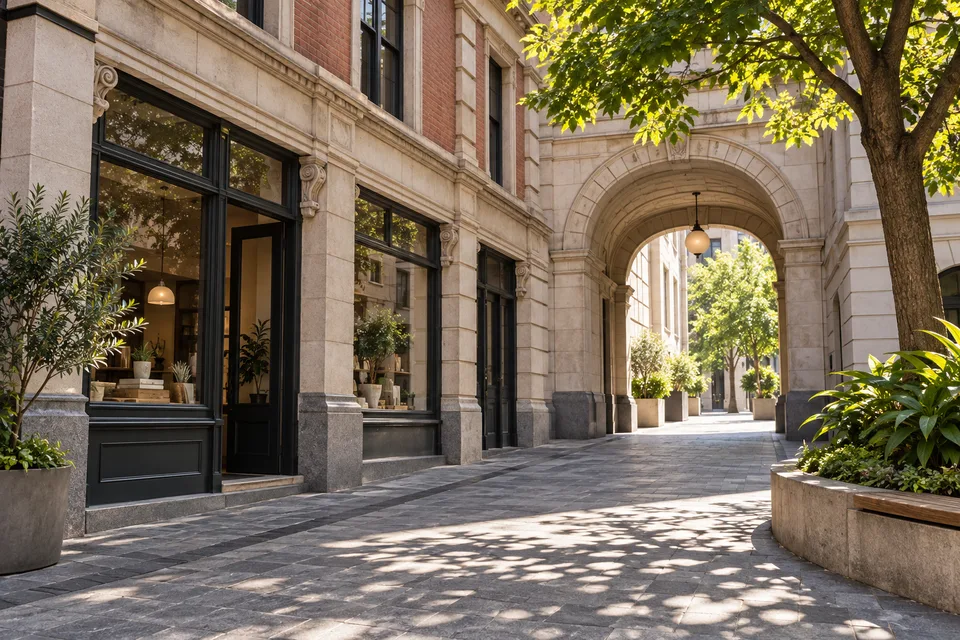
Brisbane City Centre Heritage Place Trail is a way to read the city beyond its current shopfronts and towers. The Brisbane City Council trail guide (opens in a new tab) brings together 25 points of interest across the CBD and Spring Hill, tracing stories from early colonial settlement through commercial growth and Brisbane’s role in the Second World War. It is a self-guided route, so the best approach is to choose a loop that fits the day rather than treating every stop as an obligation.
Choose the CBD or Spring Hill loop
The Council divides the trail into two shorter loops. The City Centre loop begins at the former Regent Theatre building and covers points one to nine and 19 to 25. The Spring Hill loop begins at King Edward Park and covers points 10 to 18. The downloadable guide provides addresses and a suggested route between stops. Start with that live guide, check the weather and footwear, and decide whether one loop is enough; the full trail can be completed in sections rather than as a single marathon.
This is not a trail of one architectural style or one kind of history. Council identifies points connected with the Great Fire of Brisbane in the 1860s, places of worship, architecture from the 1920s to the 1970s, the city’s first multi-storeyed apartment block and wartime history. That range is the reason to move slowly: an arcade, a station, a park shelter or a civic building can each reveal a different layer of the city.
Use individual stops as prompts, not a checklist
The City Centre loop includes the 1929 Regent Building, Brisbane Arcade, Brisbane City Hall, King George Square, Central Railway Station, Anzac Square, the General Post Office and St Stephen’s Cathedral. Some are places to enter or pause near; others are better understood from the street or their public setting. Each stop has its own access arrangements, so do not assume the trail itself guarantees entry to an interior, gallery, church or museum.
The Spring Hill loop shifts the focus uphill towards King Edward Park, the Windmill Tower, service reservoirs, Jacob’s Ladder and historic medical-precinct buildings. The Council describes the Windmill Tower as Queensland’s oldest standing building, built in 1828, while the King Edward air-raid shelter records the city’s Second World War experience. These sites are closely connected in the trail, but each deserves separate attention and any on-site conditions should take priority over a suggested route.
Plan a considerate self-guided walk
Download the current guide before setting out and use it for its addresses and route advice. The trail moves through working streets and public spaces, so stay on public access ways, respect worship and memorial sites, and avoid treating private or active buildings as open attractions. A short stop at a few chosen places can be more meaningful than rushing through the entire list.
The trail is most useful as an introduction to further exploration. If a particular site holds your attention—City Hall, Anzac Square, the Windmill Tower or a church—use the responsible institution’s own information to plan a separate visit. The Council route gives the connective tissue; individual sites provide the detail.
Sources
Sources last validated: 14 September 2026.