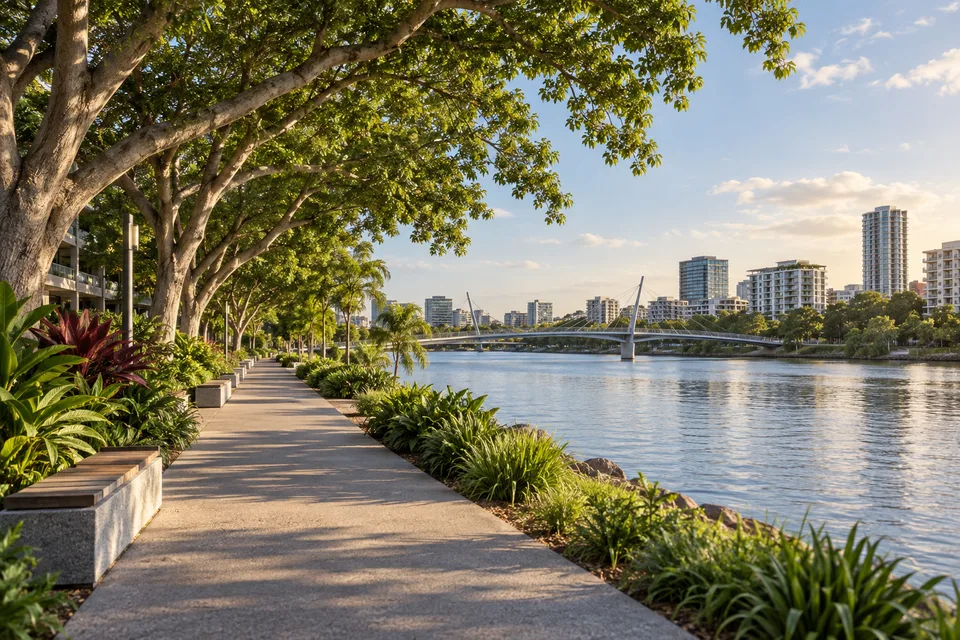
Brisbane is best understood through the connections between its river, public spaces and nearby forest rather than through a single central attraction. The official Queensland destination guide (opens in a new tab) presents the city as an outdoor-focused place with buses, trains and ferries supporting movement between precincts. That makes it possible to shape a visit around a river walk, a cultural stop and a change of terrain, while still leaving room for the slower decisions that make a city break feel personal.
Use the river as an organising line
The Brisbane River gives the city a practical as well as visual structure. Instead of treating it as a backdrop, use its banks to join the day together: begin in one precinct, walk a section of promenade, pause for a meal or an exhibition, then decide whether to continue on foot or use public transport. The city’s subtropical setting is part of the appeal, but a good plan remains responsive to the weather and the heat rather than assuming every hour needs to be outside.
South Bank is a useful first anchor because parkland, river access and major cultural institutions sit close together. The official South Bank guide (opens in a new tab) describes almost 15 hectares of lawns, Streets Beach, the riverside Clem Jones Promenade and the magenta-bougainvillea Arbour. It also identifies the Cultural Precinct, home to Queensland Art Gallery and Gallery of Modern Art, State Library of Queensland, Queensland Museum and Queensland Performing Arts Centre. This makes the precinct flexible: it can be a walk-and-picnic stop, a museum-and-gallery day, or a way to combine both without treating the parkland as merely a shortcut.
Make space for culture without relying on an old event listing
Brisbane’s event programme changes quickly, so use the live pages of a venue or precinct before building a trip around a performance, exhibition or festival. The durable reason to visit South Bank is its mix of public parkland and institutions, not a dated promise about a specific programme. If a show or exhibition matters to the trip, check the official venue page for the current date, booking conditions and access information, then allow enough time for the riverside walk around it.
Swap city streets for Mt Coot-tha Reserve
For a different scale of Brisbane, Mt Coot-tha Reserve has more than 1,600 hectares of natural area and more than 18.5 kilometres of walking tracks graded from easy to difficult. The Brisbane City Council track guide (opens in a new tab) provides specific options rather than a generic instruction to hike: the Ghost Hole Track is a 650-metre, 15-minute return walk; the Summit Track is 1.9 kilometres and around 30 minutes, with some stairs; and the Honeyeater Track is a 2.1-kilometre, one-hour moderately challenging return route. Reopen the current map and check onsite notices before setting out, particularly after wet weather or when trail work may affect access.
The reserve also has mountain-bike trails with graded difficulty, but those are not interchangeable with walking tracks. Choose a route that matches the activity, experience and time available, stay on authorised paths and heed current signage. A short forest walk can provide a genuine change of pace from the city, while a longer route deserves preparation rather than an improvised detour.
Keep the day connected
Translink’s bus, train, ferry and tram information (opens in a new tab) is the appropriate starting point for live transport planning. Check services close to travel, then use the network to connect the parts of the city that are not comfortable or practical to walk between. A balanced Brisbane day might be built around a South Bank morning, an indoor cultural visit when conditions call for it, and a separate Mt Coot-tha outing on another day. The benefit of the guide is not a rigid itinerary, but a clear set of verified building blocks.
Brisbane’s river-city identity becomes more rewarding when the day has contrast: promenade and parkland, collection and performance, then a reserve where the city recedes. Start with the live practical information, choose fewer stops than you think you need, and let the links between them do the work.
Sources
Sources last validated: 14 September 2026.